
By Screen Media Works Editorial TeamUpdated
Polyurethane screen panel aperture selection: define the duty
Start polyurethane screen panel aperture selection with the required product separation, not the closest-looking catalog photograph. Record what must pass, what must remain above the deck and how the plant checks product quality. A grading duty, a washing screen and a drainage position can require different compromises even when their panels look similar. Keep the current panel drawing and the operating evidence together.
Metso's handbook distinguishes opening shapes and slot orientation, while McLanahan discusses media trade-offs. Neither provides a universal replacement specification for your plant. Before comparing quotations, identify the machine, deck position, support arrangement and existing failure mode. If the feed, required cut or acceptance method is unknown, describe it as unresolved rather than asking a supplier to select an opening from photographs alone.
1. Square openings: confirm the separation requirement
Square openings are a useful starting point for discussing a grading duty, but their appearance does not establish the resulting cut. Ask which drawing defines the opening and which face is measured. Record particle shape and the proportion of material close to the required separation. Compare actual feed and product samples using the plant's agreed sampling procedure, not a visual estimate of the aperture.
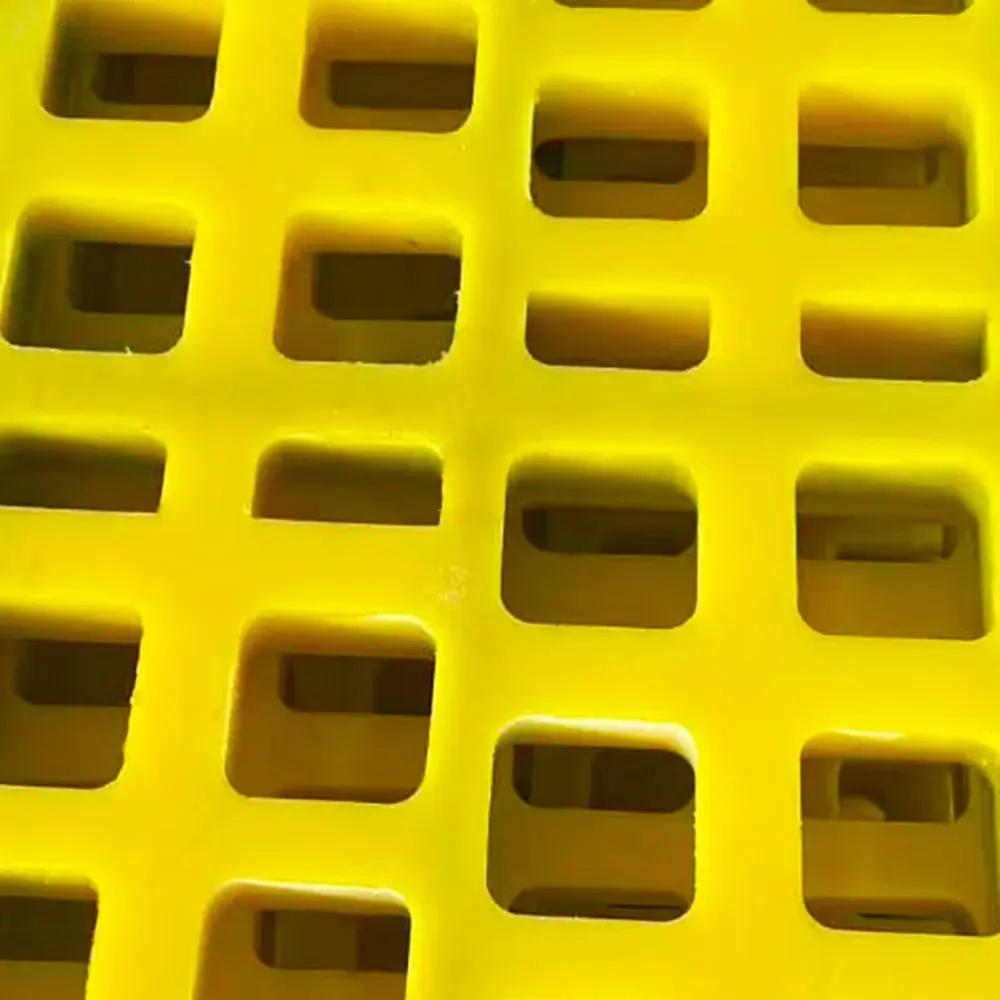
A worn opening is not an appropriate manufacturing reference without qualification. Mark whether measurements come from a new spare, an unworn region or a used panel. Ask the maintenance team to identify rounded edges, damaged ligaments and local distortion. The yellow close-up above illustrates appearance only. Perspective and visible edge radii cannot prove an exact square geometry, a measured size or a particular manufacturer's specification.
2. Slotted openings: record width, length and direction
A slot description needs more than its narrow dimension. Record length, width and orientation relative to material travel on a marked drawing. Metso's handbook treats slots along and across the flow as distinct selection options. For purchasing, preserve that direction in the enquiry and ask how the proposed layout relates to the required grading or drainage duty.
Do not rotate a replacement simply because its perimeter appears to fit. Identify elongated feed particles and any observed misplaced material in the product. For wet duties, include fines retention and discharge moisture observations rather than equating a longer slot with better dewatering. Ask for an explicit review of the proposed opening arrangement; a panel-family name does not settle process suitability or its connection to the deck.
3. Round openings: separate shape from proof of suitability
Round openings are another documented media option, not a substitute for establishing the required separation. Identify whether the reference really has a circular opening or merely appears rounded after wear. Supply a drawing or a traceable sample and show the inspection face. Do not transfer a dimension from a neighbouring square-opening panel or infer a material formulation from colour.
When changing shape, define the reason and acceptance evidence before ordering. A comparison should address product grading, blockage observations and the actual usable screening surface. Keep the existing reference identifiable throughout the review so that a proposed change cannot be mistaken for a like-for-like spare. Ask the supplier to distinguish confirmed geometry from details still requiring measurement or trial.
4. Tapered openings: verify the through-thickness profile
An opening can differ between the screening face and underside. Metso describes moulded tapered openings in connection with pegging reduction, but taper is not a guarantee against blockage. Request a section drawing showing the intended passage and identify which surface controls the specified opening. A front photograph cannot establish the complete profile through the panel thickness.
Distinguish particles lodged in openings from fines adhering over them. Metso and Sandvik discuss these as different problems with different contributing conditions. Ask for safe shutdown photographs of both surfaces and note where obstruction is concentrated. Do not assume that taper alone resolves sticky feed, uneven loading or an unsuitable operating condition. Equipment adjustments remain subject to the machine manufacturer's instructions.
5. Open area: compare like-for-like working surfaces
Ask what area and denominator a quoted open-area figure describes. Metso distinguishes relative open area from effective open area; supports and non-screening regions matter when comparing installed arrangements. A close-up of a perforated patch cannot describe the whole deck. Obtain the panel layout and identify borders, blank sections, reinforcing regions and support coverage before comparing alternatives.
More visible holes are not, by themselves, evidence of higher plant capacity or an acceptable product. Check the same duty, panel position and available working surface. McLanahan's media guidance frames selection as a balance rather than a single percentage. Record any proposed change in ligament geometry or support exposure for technical review instead of treating open area as an independent purchasing target.
6. Match the observed blockage mechanism before changing media
Document whether openings contain trapped particles, a coating of fines or both. Note feed moisture changes, distribution across the deck and whether the issue is local or widespread. Sandvik's troubleshooting guidance supports investigating the operating context. The useful purchasing evidence is a repeatable observation tied to a particular deck position, not the general statement that polyurethane should solve the problem.
Where a change is proposed, agree a limited comparison and its acceptance criteria with the responsible plant team. Keep feed conditions, inspection timing and product checks recorded. Do not promise a capacity increase or longer life from shape alone. A successful review may instead identify a support, loading or maintenance issue outside the panel supply scope.
Comparison checklist for polyurethane screen panel aperture selection
Use this checklist to define the quotation evidence, not as a universal ranking of opening types.
| Option or check | Evidence to compare | Boundary |
|---|---|---|
| Square | Drawing, inspection face and product grading. | Appearance does not establish the cut. |
| Slots along flow | Width, length, direction and particle shape. | Perimeter fit does not approve rotation. |
| Slots across flow | Drainage duty and fines-retention evidence. | Longer slots do not guarantee drier product. |
| Round | Traceable geometry and reason for changing shape. | Do not copy a square-opening specification. |
| Tapered passage | Face and underside profile on a section drawing. | Taper cannot guarantee freedom from blockage. |
| Working open area | Whole-panel layout and support coverage. | A photograph cannot establish plant capacity. |
Send an aperture enquiry with a controlled reference
Use the Modular or Dewatering page to identify the family, then the Replacement Guide to organize measurements. Send the known duty and reference through RFQ. Ask the quotation to separate confirmed geometry, outstanding questions and any required trial.
Standard panels are in stock (3–7 day lead time); custom panels are made to drawing or sample (lead time confirmed per drawing or tooling), with no MOQ and worldwide shipping. Confirm the requested configuration; this is not an inventory promise for every aperture.
- Machine, deck position, support layout and required quantity.
- Same-reference face, underside and edge photographs with a drawing revision.
- Required separation, feed description and current product checks.
- Blockage evidence, proposed change and delivery destination.
Related resources
- Modular Polyurethane Screen Panels
Identify the panel and existing support interface before reviewing its opening.
- Polyurethane Dewatering Screen Panels
Separate drainage and fines-retention requirements from appearance.
- Screen Panel Replacement Guide
Prepare traceable measurements and photographs of the reference panel.
- Request a Quote
Send the duty, drawing and unresolved aperture details for review.
- Vibrating Screen Blinding vs Pegging: 6 Checks
Distinguish adhering fines from particles trapped in openings.
- Polyurethane Dewatering Screen Panels: 7 Critical Factors
Review the wet-duty evidence needed alongside an aperture proposal.
Technical references
- Metso — Screening Media Handbook, Version 2.1
Opening-shape, slot-orientation, taper and relative/effective open-area distinctions. OEM catalog examples are not SMW specifications.
- Metso — How to reduce pegging and blinding
Distinguishes trapped particles from adhering fines. No universal anti-blockage result is implied.
- McLanahan — How to Choose the Right Type of Screen Media for Your Aggregate Plant
Selection trade-offs across media types; not a capacity prediction for a proposed aperture.
- Sandvik — Trouble shooting examples
Operating and feed context for screening problems. Machine changes require equipment-specific review.