
By Screen Media Works Editorial TeamUpdated
1. Define the duty for polyurethane dewatering screen panels
Polyurethane dewatering screen panels are only one part of a screen-and-process system. Select them against seven factors: process target, feed conditions, aperture size, slot geometry and open area, panel construction, overall dimensions, and the support and attachment interface. Review the required throughput, feed gradation, solids concentration, water load, target product and the mechanical design of the screen. Define whether the goal is a drip-free product, a measured moisture range or a solids-retention requirement; these are not interchangeable targets.
Do not treat a moisture figure reported for another plant or material as a guaranteed result. The discharge moisture depends on both the drainage rate of the screen and the drainage behavior of the material. Fine or interlocking particles can retain more water than coarser, free-draining material, even when the discharge appears drip-free.
2. Record the feed and equipment conditions
Record steady and peak feed rates, feed solids by weight, solids specific gravity, particle-size distribution, percentage of fines, clay or slime content, particle shape, temperature and relevant chemical exposure. Identify whether the stream is washed sand, tailings, concentrate, coal slime or another material. A feed-concentration target from another OEM should not be copied without checking the actual screen, solids density and process circuit.
Also record the screen manufacturer and model, deck width and length, number of decks, inclination, feed distribution, motion and stroke information from the OEM manual, support-beam layout, and any weirs or cross-dams. The media cannot compensate for an overloaded or poorly balanced screen.
- Separate normal operating conditions from short peak-load conditions.
- Use a representative feed-size distribution rather than only the nominal top size.
- Record the actual target product and any fines that must remain in the discharge.
3. Balance aperture size against drainage and fines retention
The opening must pass enough water while retaining the required solids. Increasing the opening can raise drainage, but it can also send saleable fines to the underflow. Reducing the opening may improve retention but restrict drainage and leave the discharge wetter. Select the aperture from the required product cut and feed gradation, not from the word dewatering alone.
Fine particles can follow the water through the openings. If fines retention is important, review the whole process circuit and whether the material can remain on the deck long enough to drain; do not simply reduce the opening without checking the resulting drainage and capacity.
4. Compare slot geometry and effective open area
Compare opening shape and effective open area together. Metso's Screening Media Handbook includes an indicative dewatering drainage-rate graph plotted against effective open area. In that graph, slotted aperture families (SLS/STS) are shown above square apertures (FR) across the plotted range. In the same handbook, SLS means slots aligned with material flow and STS means slots across the flow; these codes describe orientation relative to the material path. The handbook labels the graph an indicative tool; it is a design comparison, not a guaranteed plant-capacity result.
Ask for the aperture dimensions, slot length and width, slot orientation, tolerance and effective open-area figure. Compare only products calculated on the same basis and confirm whether the quoted open area describes the panel or the installed deck.
5. Match panel thickness and construction to the duty
Panel thickness and wear construction affect the balance between screen capacity, separation accuracy and service life. Metso's general screening-media guide describes a trade-off: thinner media can favor capacity and separation accuracy and may reduce blinding/pegging tendency, while thicker media can favor wear life and may increase that tendency. These are general trade-offs, not a universal thickness formula for every dewatering screen; the correct design depends on feed size, abrasiveness, impact, support and required aperture geometry.
Confirm the polyurethane grade, hardness, total thickness, wear thickness, aperture geometry and compatibility with the feed temperature and chemistry. Do not infer hardness or thickness from another supplier's product or assume all polyurethane grades have the same properties.
6. Confirm panel dimensions against the current panel or drawing
Standard panels are in stock; custom panels are made to drawing or sample. Confirm the required footprint and thickness against the current panel, installed deck and drawing before selecting a replacement.
Measure slot width and slot length separately from the current panel or drawing, together with slot orientation and tolerances. A nominal slot description alone does not establish effective open area or fines-retention performance.
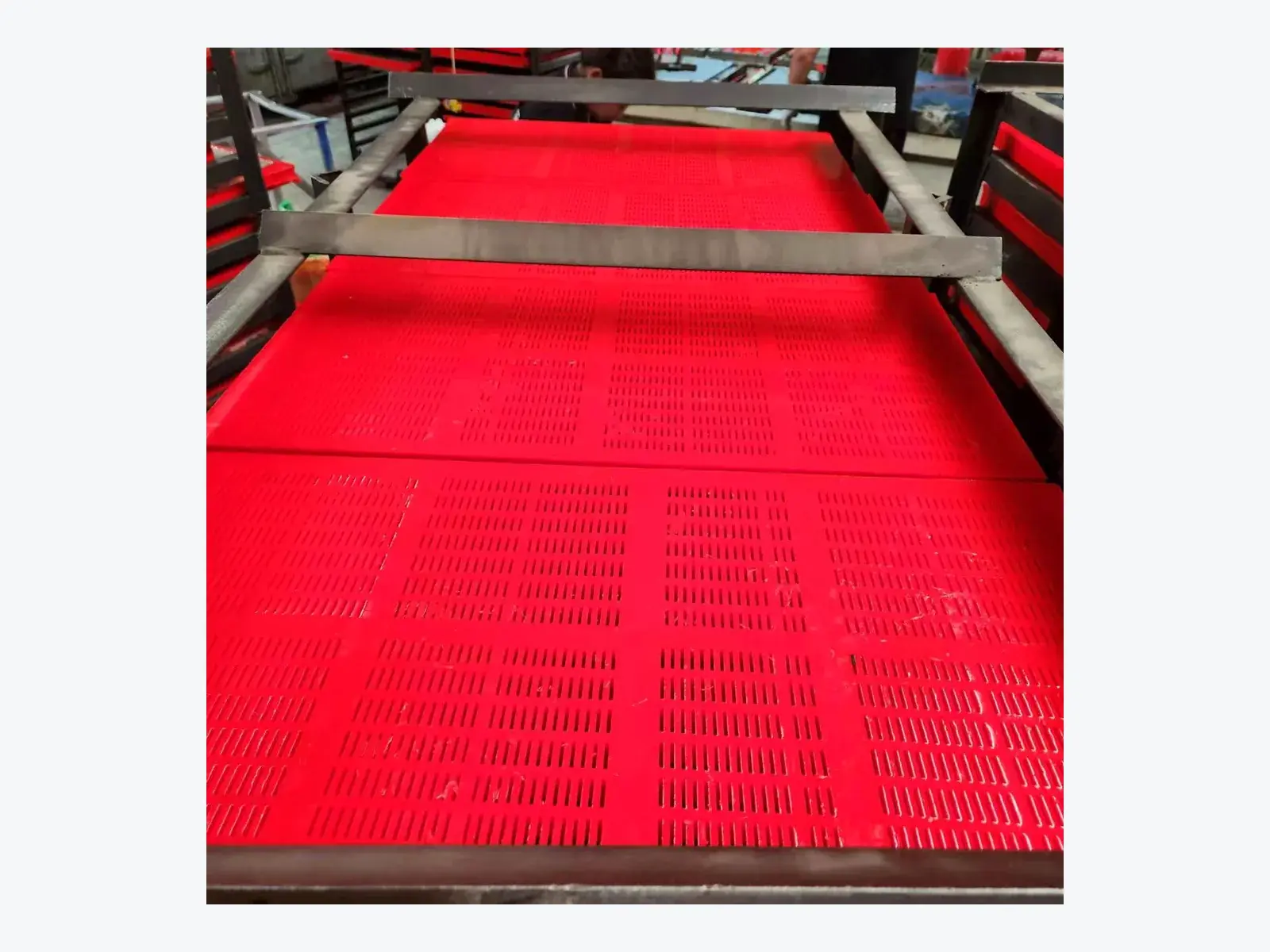
A wave- or hump-profile dewatering panel has a raised surface that differs from a flat slotted module. The opening form, raised-feature orientation, support profile and attachment arrangement need a drawing or physical reference before comparison.
Use measurements from the current panel or drawing to identify what should be confirmed, not as an inventory list or an OEM drop-in compatibility claim. The correct replacement is determined by the installed panel, support interface, working duty and confirmed order-specific drawing.
- Record the panel's length and width in millimeters, and distinguish total thickness from the height of any raised ribs or weirs.
- Specify slot width and slot length separately, together with slot orientation, tolerances and any blocked or blank areas.
- For wave-profile panels, confirm the ridge direction, ridge height, underside and fixing geometry; do not substitute a flat-panel specification.
7. Match polyurethane dewatering screen panels to the deck interface
Record the complete panel dimensions, including length, width, overall height and wear-layer thickness. Identify the actual retention system, such as pin-and-sleeve, bolted or hold-down, rail or wedge retention, or another OEM-specific arrangement. Confirm it from the equipment drawing or an installed sample rather than assuming a standard interface. Check support profiles, contact surfaces, panel engagement, edge sealing, divider attachment and any orientation marks.
A panel with the correct nominal dimensions may still be incompatible if its support profile or fastening geometry differs. Use the equipment drawing, installed panel sample or OEM specification to confirm the replacement interface before manufacture.
Troubleshoot wet discharge before enlarging the aperture
If the product is too wet, check cyclone or separator underflow density, classifying-tank discharge for excessive dilution, material bed, screen motion, blocked apertures, damaged media and whether water is encroaching too far toward the discharge end. McLanahan lists increasing panel aperture as one possible adjustment, but advises checking process limitations with the factory. A larger aperture may improve drainage while also increasing fines loss. Treat it as one option after the upstream-density, dilution, cross-dam and screen-motion checks—not as an automatic first response.
If those checks do not identify the bottleneck, compare the proposed aperture with the required product cut and fines-retention target. Confirm the change with the screen supplier or OEM and validate drainage and fines loss under the actual feed conditions.
Compare options under equivalent operating conditions
When comparing polyurethane dewatering screen panels, use the same feed and operating conditions. Record throughput, discharge moisture, fines lost to the underflow, wear pattern, operating hours and maintenance frequency. If possible, change one design variable at a time and compare results over a representative operating period.
A catalog open-area percentage or a single moisture result from another plant is not proof of performance on your screen. Validate the proposed panel on the actual machine and material, and confirm any trial limits with the screen OEM.
Information to include in a quotation request
A useful quotation review starts with the installed equipment and process conditions. If some measurements are unavailable, send the information you have and identify what still needs to be measured.
- Screen manufacturer, model, machine reference, deck dimensions and number of decks.
- Current panel dimensions: length, width, overall height, total thickness and wear thickness.
- Aperture shape, width, length, slot orientation, tolerance and effective open area if available.
- Attachment method, support-beam profile, divider details and any installation drawing or sample.
- Feed material, throughput range, particle-size distribution, solids concentration, specific gravity, fines or clay content, temperature and chemistry.
- Target discharge moisture or drip-free requirement, required product cut, fines-retention target and current operating problem.
- Photos of the installed deck, panel underside, support and fastening details, plus worn or damaged areas.
- Required quantity, replacement schedule, destination and requested delivery date.
Selection checklist
Use the following checklist to compare proposed panels on the same process and installation basis.
| Selection factor | What to record | Why it matters |
|---|---|---|
| Feed and gradation | Throughput, particle-size distribution, fines, clay and particle shape | Controls how readily water drains through the material bed and how much fine material may follow the water. |
| Discharge target | Drip-free target, moisture range, product cut and fines-retention requirement | Defines the result to be balanced against drainage and solids loss. |
| Aperture design | Opening shape, width, length, orientation and tolerance | Balances water passage against retention of the required solids. |
| Effective open area | Panel EOA and calculation basis; record support zones and blank areas separately | Supports comparison of media open-area potential. Document deck-level obstructions separately because supports and clamping zones reduce the usable installed area. |
| Panel construction | Polyurethane grade, hardness, total thickness and wear thickness | Balances drainage, separation, wear life and compatibility with the duty. |
| Deck interface | OEM/model, panel dimensions, support profile, fasteners and dividers | Prevents fit, sealing, attachment and premature-wear problems. |
Final recommendation
Selecting polyurethane dewatering screen panels means matching the process target, material drainage behavior, screen drainage capacity and exact deck interface. Confirm those four items before choosing an aperture or requesting a quote. The final moisture and throughput must be validated against the actual feed and screen; neither can be guaranteed from panel material or nominal opening size alone.
Related resources
- Polyurethane Dewatering Screen Panels
Review the dewatering panel family and prepare the dimensions and aperture details needed for a compatibility check.
- Sand Washing and Dewatering Applications
Review wet-screening, water-removal and fines-retention conditions in sand-washing circuits.
- Aggregate Screening Applications
Review feed conditions, separation targets and wet or dry screening requirements for aggregate applications.
- Vibrating Screen Blinding vs Pegging: 6 Checks
Document blocked openings alongside the wet-process and drainage evidence.
- Polyurethane vs Rubber vs Woven Wire Screen Media: 3-Way Guide
Review material-selection trade-offs without assuming one media type suits every duty.
Technical references
- McLanahan — How To Size a Dewatering Screen For Your Sand Plant
Revised March 16, 2025. Manufacturer guidance on the combined effects of equipment design, target discharge moisture, screen drainage, material drainage, gradation, open area and fines retention.
- Metso — Screening Media Handbook, Version 2.1 (September 2024)
Printed page 333 contains an indicative dewatering drainage-rate graph against effective open area, comparing slotted aperture families (SLS/STS) with square apertures (FR). Treat the graph as a design guide, not a capacity guarantee.
- McLanahan — Dewatering Screens Support
OEM support guidance covering media inspection, cracks and enlarged slots, upstream feed-density checks, cross-dams, screen motion and factory review before changing apertures.
- Metso — Basics in Minerals Processing Handbook, Edition 12, Section 4.8
Printed page 86 gives general screening-media thickness and selection trade-offs. Use these as broad design considerations, not as a universal dewatering-panel thickness formula.