
By Screen Media Works Editorial TeamUpdated
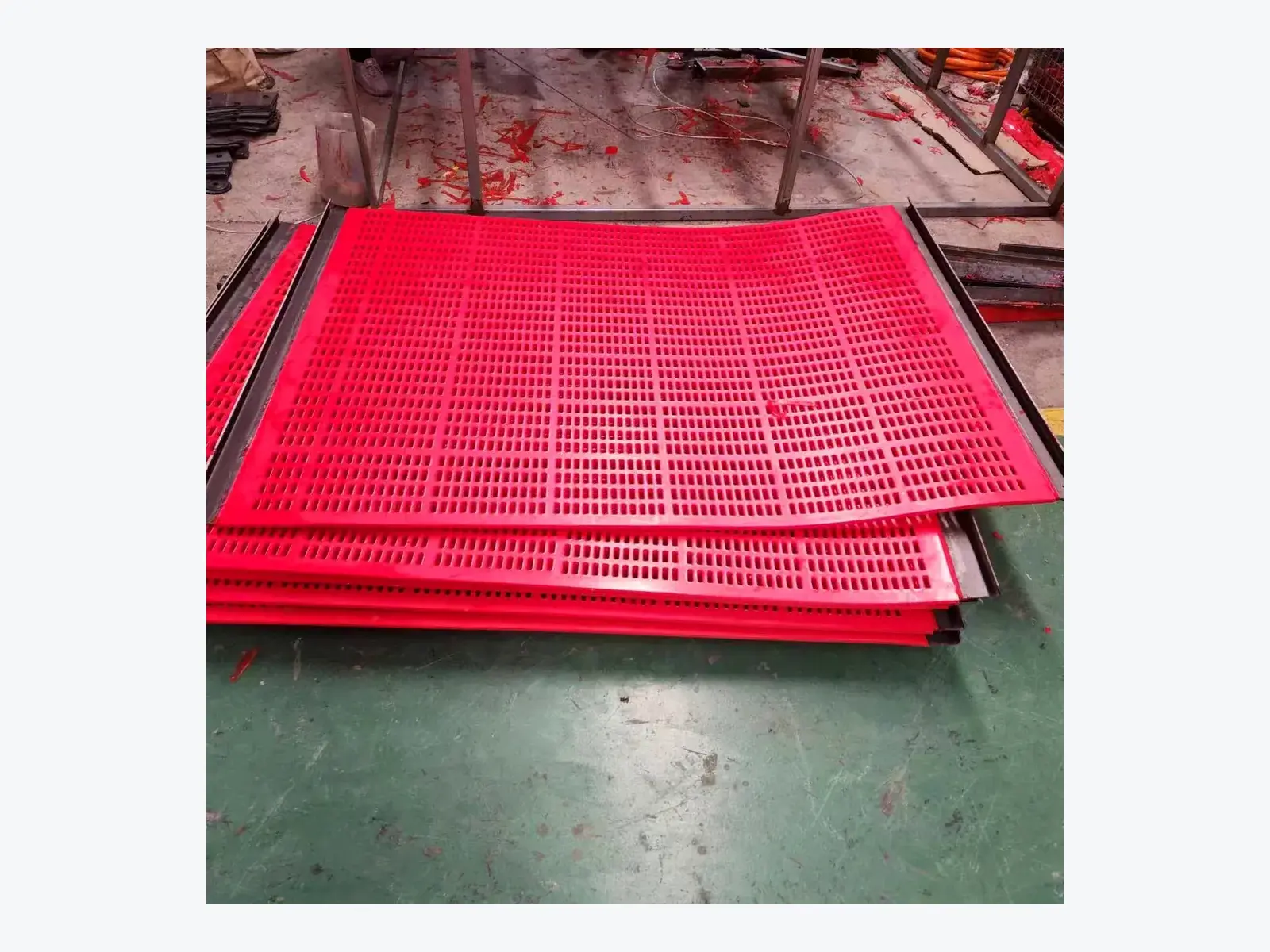
Tensioned vs modular polyurethane screen panels: start with the deck
Choosing tensioned vs modular polyurethane screen panels starts with the installed deck, not with the polymer name. Establish how the current media is supported, retained and replaced before comparing aperture options. A material change and a mounting-system conversion are different purchasing decisions; a photograph of the screening surface alone does not establish either scope.
Tensioned media and individual modules are not interchangeable merely because both are polyurethane. Use the checks below to prepare a replacement enquiry or identify the information required for a conversion review. Keep the machine reference, deck position and current drawing together. Where those records are missing, mark measurements as provisional rather than treating a visually similar panel as a confirmed fit.
1. Existing deck frame and conversion scope
Identify whether the deck currently uses tensioned sheets or cloths, individual retained modules, or another arrangement. Photograph the empty support frame during a safe, planned maintenance stop. Include the side rails, intermediate supports, feed end and discharge end. Note which parts remain on the machine when the media is removed and which are supplied with a replacement.
For a like-for-like order, ask the supplier to identify the drawing and interface being matched. For a proposed conversion, request a separate list of altered supports, retention parts, sealing details and installation work. Do not approve a conversion from panel dimensions alone. Establish who checks the machine changes and whether the screen OEM needs to review them before committing to a different media family.
2. Tensioning direction and hook-edge geometry
For tensioned media, record the tensioning direction and show both hook edges, their profiles and the mating clamping rails. Measure the installed sheet and support arrangement against its drawing; distinguish free-state measurements from dimensions recorded under tension. A hook that looks similar from above may have a different engagement profile, so include a clear end view with the measurement reference visible.
Sandvik's maintenance guidance warns that incorrect or uneven tension can damage screening media. It also emphasizes contact with the intended camber supports. Use the installation procedure for the exact machine and media; do not borrow another product's tension values. Ask whether clamps, hold-down parts and capping rubber are serviceable and whether they belong in the quotation. Replacing the sheet does not repair a worn retaining interface.
3. Modular fixing systems and support profiles
For modular media, identify each actual retaining feature rather than ordering from a broad label such as pin-fixed. Record the module footprint, underside support surfaces, edge engagement and the mating hardware. Pin, rail, wedge or bolted arrangements are possibilities to identify, not a declaration that every version is available or compatible. Send front, underside and edge photographs of the same reference module.
Ask which components are reusable and which must be renewed with the panel. Keep panel and hardware references paired in the enquiry, especially when an earlier repair introduced mixed parts. A loose accessory photographed separately cannot confirm its location or fit. Where the underside cannot be inspected, request the equipment drawing or a removed sample before finalizing the replacement interface. Label any unverified feature explicitly.
4. Effective open area, blinding and aperture options
Compare aperture shape, orientation, membrane construction and open-area calculations on the same basis. Metso's handbook describes relative open area (ROA) using aperture size and pitch; that calculation does not account for product size or blind areas. Its comparison with effective open area (EOA) shows why support and clamping obstructions also matter. Do not treat a cloth ROA figure as the usable area of an installed deck.
Request each supplier's EOA calculation basis and identify blank zones separately. Record the required separation, current aperture measurements and any deposits or trapped particles. Compare the proposed opening against product-quality requirements before changing it. An apparent open-area advantage is not proof of higher plant throughput: the comparison still needs the feed, available screening area, deck geometry and operating conditions. Keep the submitted calculation with the quoted drawing for later review.
5. Replacement downtime and partial-deck maintenance
Define the changeout task before comparing maintenance claims. An individually retained module may permit replacement of a localized worn area when the surrounding system is sound. A tensioned arrangement requires its own removal and re-tensioning procedure. Neither description establishes a changeout time for your machine. Confirm access, lifting needs, isolation procedures and the condition of adjoining media with the maintenance team.
For a partial-deck order, mark the affected positions on a sketch and identify adjoining edges and any special end pieces. Record the parts and work included in the comparison, not just the price of the screening surface. Ask whether a proposed repair changes the aperture pattern or interface next to retained panels. Use your recorded service history to evaluate the options; a generic claim about faster replacement is not a site maintenance plan.
6. Feed impact, moisture and load limits
Record feed material, size distribution, moisture, throughput and the location where material reaches the deck. McLanahan's selection guidance treats open area and media life as a trade-off and warns against exceeding the screen's loading capability. A change to polyurethane does not remove the need to check the machine's operating envelope or the selected media's application limits.
Ask for the proposed construction's limits for impact, particle size, bulk density, temperature and relevant chemical exposure. Distinguish measured data from estimates. Include photographs of localized damage and the feed chute, but do not infer material grade or remaining life from their appearance. If either family would require different supports or operating settings, identify that work for equipment-level review rather than leaving it implicit in a replacement-panel quote.
Side-by-side comparison: tensioned vs modular polyurethane screen panels
Use this comparison to organize evidence, not to rank one construction as universally better. Evaluate both options against the same separation duty and the actual deck. Leave an item open when its drawing or operating information has not yet been confirmed.
| Check | Tensioned media | Modular media |
|---|---|---|
| Deck and conversion scope | Identify rails, camber and sheet arrangement. | Identify the module support grid and retained frame parts. |
| Retaining interface | Match hook profile, clamping rail and tensioning direction. | Match underside engagement, edge profile and the actual fixing hardware. |
| Support condition | Inspect support contact and capping rubber. | Inspect module seating and each intended retention point. |
| Open-area comparison | State ROA or EOA basis and support/clamp obstructions. | State EOA basis, panel borders and blank zones. |
| Maintenance scope | Confirm removal and re-tensioning procedure. | Confirm whether the identified positions can be replaced independently. |
| Operating duty | Check the specified sheet against feed, impact and loading. | Check the specified module construction against the same duty. |
What to measure and photograph before requesting a quote
A useful enquiry about tensioned vs modular polyurethane screen panels separates verified dimensions from a proposed redesign. State whether you want a like-for-like replacement, a partial-deck repair or a conversion assessment. Send the information available now and identify any missing underside or fixing detail; a drawing or sample can resolve details that photographs cannot establish.
Standard panels are in stock (3–7 day lead time); custom panels are made to drawing or sample (lead time confirmed per drawing or tooling), with no MOQ and worldwide shipping. Confirm the requested configuration and availability before ordering; these supply terms do not establish that every hook profile or modular interface is held in stock.
- Machine reference, deck position, current drawing and quantity by position.
- Measured overall length, width, thickness, aperture shape and aperture dimensions.
- Hook and clamp profiles or module underside and fixing details, with support spacing.
- Overall deck, top, underside, edge and worn-area photographs tied to the same reference.
- Feed conditions, observed problem, service history, required quantity and delivery destination.
Related resources
- Tensioned Polyurethane Screen Panels
Review hook-edge and tensioned-media identification information.
- Modular Polyurethane Screen Panels
Review modular panel, support and fixing identification.
- Screen Panel Replacement Guide
Prepare measurements and photos without assuming installation compatibility.
- Request a Quote
Send the current reference and known duty for a replacement review.
- Modular Polyurethane Screen Fixing Systems: 4 Types
Identify the complete modular connection before comparing it with a tensioned arrangement.
- Vibrating Screen Panel Wear: 6 Common Failure Causes
Organize support, loading and wear observations for the replacement review.
Technical references
- Metso — Screening Media Handbook, Version 2.1
Printed pages 330–332 distinguish ROA from EOA and illustrate the importance of supports, clamps and deck geometry. Examples are not SMW performance guarantees.
- Sandvik — Maintenance and replacement advice
Guidance on tensioned-media installation, support contact, retention and wear. Use the exact equipment instructions, not values transferred from another system.
- McLanahan — How to Choose the Right Type of Screen Media for Your Aggregate Plant
General media-selection trade-offs and loading considerations; not a universal material ranking or a supply specification.